Our Services are:
24/7 Support
At Premium Quality
30 Days Gurantee
No One Is Equal To Us
99.9% Uptime
Our Top Priority.

In computing, DDR4 SDRAM, an abbreviation for double data rate type four synchronous dynamic random-access memory, is a type of dynamic random-access memory (DRAM) with a high bandwidth interface currently under development and expected market release in 2012. As a "next generation" successor to DDR3 SDRAM, it is one of several variants of DRAM used since the early 1970s. It is not directly compatible with any earlier type of random access memory (RAM) due to different signaling voltages, timings, physical interface and other factors.

DDR4 itself is a DRAM interface specification. Its primary benefits compared to DDR3 include a higher range of clock frequencies and data transfer rates (2133–4266 MHz and MT/s compared to DDR3's 800–2133) and significantly lower voltage (1.2 decreasing to 1.05 volts, compared to 1.5 – 1.2 V for DDR3). DDR4 also anticipates a change in topology – it discards dual and triple channel approaches in favor of point-to-point where each channel in the memory controller is connected to a single module. Switched memory banks are also an anticipated option for servers.
DDR4 SDRAM
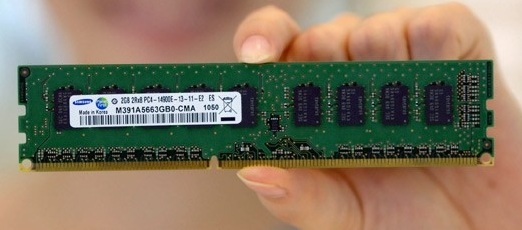
The first DDR4 memory module was manufactured by Samsung and announced in January 2011.
For graphics DDR4
